Jul 1, 2026
The Automation Ladder
Teams start with the technology instead of the work. They assume the challenge is finding the right model, writing the right prompt, or choosing the right tool. Months later, they've built something nobody trusts, or something so fragile it requires constant maintenance.
"The model wasn't good enough." "Fixing its output took longer than just doing the work myself."
Those are real observations, but they're often the wrong diagnosis.
More often than not, it's a you problem, not an AI problem.
It fails because the work was never understood well enough to automate.
If you can't explain how work gets done, AI can't perform it. If you can't define a successful outcome, AI can't optimize for it. AI executes against your instructions, not your intentions.
The model isn't guessing what you meant. It's executing what you wrote.
Instead of asking, "How do we use AI here?" ask, "How well do we understand this work?"
Once you adopt that lens, a different pattern emerges.
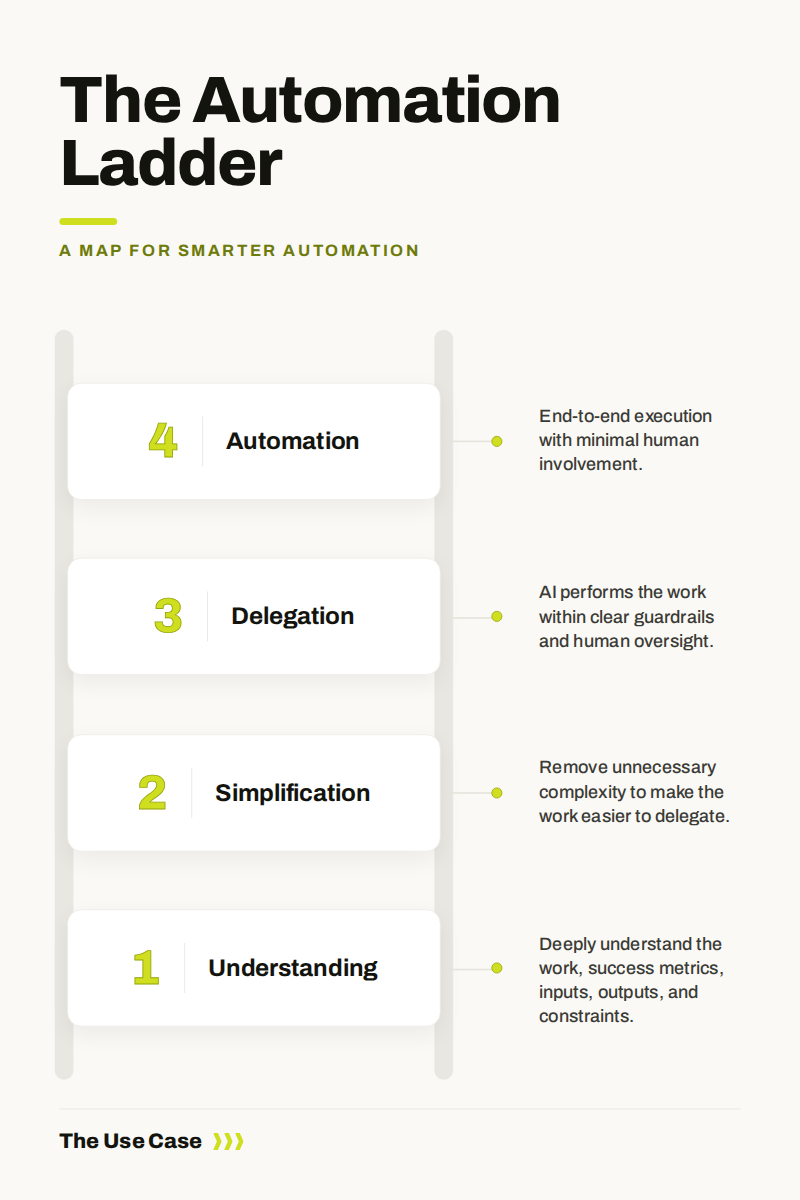
I think of it as the Automation Ladder.
1. Understanding
The first rung is understanding. Before deciding whether AI belongs in a process, define what the process actually is.
"Automate accounting" is too broad. "Categorize monthly bank transactions using our chart of accounts" is actionable.
The opening of this prompt shows what that clarity actually looks like in practice.
The purpose of this project is to prepare monthly financial statements for a rental property by analyzing a monthly bank statement, categorizing transactions according to the property's Chart of Accounts, and producing a standardized Excel-based financial report.
Business processes are collections of smaller decisions stitched together.
That's why documenting how the work gets done today matters more than mapping the future state. Which inputs affect the outcome? Where is judgment required? Much of this has nothing to do with AI.
2. Simplification
The second rung is simplification. Not every problem deserves AI.
Sometimes the best solution is an existing integration. Sometimes it's replacing outdated software. Sometimes it's eliminating a step.
Part of simplifying the work is confronting the constraints instead of pretending they don't exist.
Maybe the ERP can't integrate. Maybe leadership won't replace legacy software. Maybe the economics don't justify a fully autonomous workflow.
Those constraints aren't reasons to abandon automation. They're design inputs.
The objective isn't to maximize AI usage. It's to minimize unnecessary complexity.
Only after simplifying the work should you ask where AI creates leverage.
3. Delegation
The third rung is delegation. This is where most professionals should spend their time.
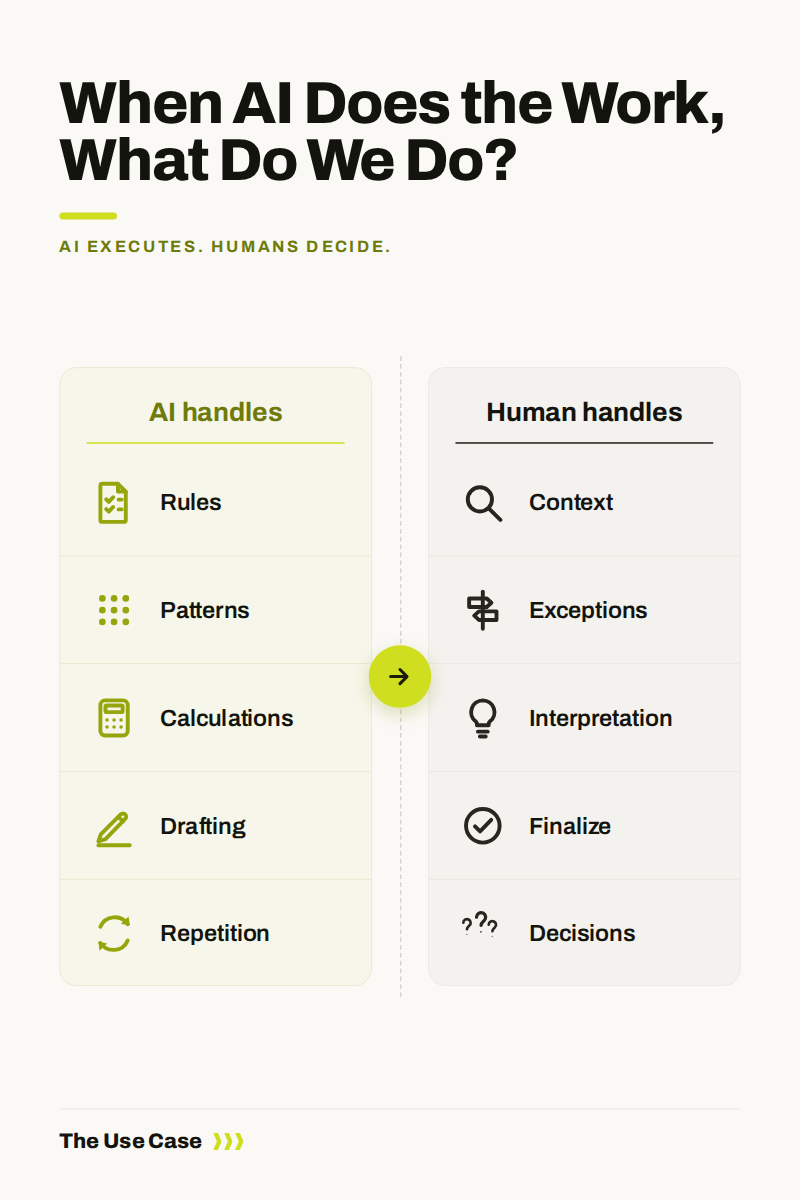
AI isn't replacing humans. It's compressing repetitive portions of the work while preserving human judgment where it matters most.
Consider a monthly accounting process. The mechanics are repetitive. Categorize transactions. Apply consistent rules. Format reports. Prepare analyses. Those are ideal candidates for AI. The accountant's value shifts from execution to judgment.
The prompt draws that line explicitly. It automates the repetitive coding, then hands the ambiguous cases back to a person rather than guessing:
Assign each transaction to the appropriate account based on the Chart of Accounts reflected in the historical deliverables. Apply consistent categorization from month to month. If there is insufficient information to determine the correct account classification, place the transaction on the Transactions Requiring Review tab. Do not assign categories based on speculation or unsupported assumptions.
Instead of spending hours assembling information, they're explaining why a number moved, catching misclassifications, and advising the business on what the numbers actually mean.
The output improves because human attention is spent where it's most valuable.
Good automation doesn't eliminate expertise. It delegates the repeatable work so people can focus on the decisions that require judgment.
4. Automation
The fourth rung is automation. This is where expectations often become disconnected from reality.
Fully autonomous systems sound attractive because they promise to eliminate human involvement entirely. In practice, the question isn't whether autonomy is technically possible — it's whether the effort produces a meaningful return.
Imagine a small company with two monthly bank statements.
Building an agent that logs in to the bank and retrieves statements might eliminate two minutes of manual effort each month.
Now imagine a holding company managing thirty operating businesses, each with multiple bank accounts.
The economics change entirely.
The automation is no longer eliminating two minutes. It's eliminating hours of work.
The level of automation should match the scale of the problem. Climbing higher on the ladder isn't inherently better. It's only better when the additional complexity produces proportional returns.
This reframes another common misunderstanding about AI maturity.
People often think expertise means building autonomous agents.
It doesn't.
Expertise means consistently selecting the appropriate rung of the ladder.
Sometimes that means having a conversation with ChatGPT. Sometimes it means creating a reusable prompt. Sometimes it means full automation.
The skill isn't maximizing autonomy. The skill is matching the solution to the economics of the work.
Clarity beats clever prompting
Take the example of using AI to categorize transactions on monthly bank statements. The prompt isn't merely a set of instructions. It's the knowledge required to perform the work consistently. It defines:
- the purpose of the process
- the business context
- the required inputs
- decision rules
- examples
- expected deliverables
The sophistication doesn't come from clever prompting. It comes from clarity.
That's the part many people miss.
When AI performs poorly, the instinct is to blame the model.
The biggest mistake I see is people describing the work but never defining the result.
They explain the process. They explain the rules. But they never specify the output.
Every time AI responds, it invents a new structure.
Now you're spending your saved time reformatting, reorganizing, and interpreting the response instead of reviewing the work itself.
A good prompt refuses to leave the output vague.
Imagine onboarding a new employee.
You wouldn't say, "Handle accounting."
You'd explain the objective, provide examples, establish review procedures, and specify what success looks like.
AI deserves the same treatment because, fundamentally, you're doing the same thing.
You're transferring knowledge.
The competitive advantage isn't better prompts. It's better process design.
The professionals who benefit most won't be those who know every model or framework. They'll be the ones who can turn expertise into repeatable systems that AI can execute consistently.
This skill has always been valuable. AI simply increases its leverage.
AI has introduced a new vocabulary.
Agents. MCP. Skills. Models.
The terminology is fresh. The principles that make it work are not.
AI didn't invent the requirement to define a goal, document a process, and standardize an output. It simply made the cost of skipping those steps impossible to ignore.
The Automation Ladder isn't really about automation. It's about understanding.
The higher you climb, the less AI is the story. The system is.
AI doesn't replace operational excellence. It compounds it.